Thursday, 2 October 2014

Banded Shorebirds

I think I must have been here too long, I'm picking up the lingo. Ringed Waders to those of us from the other side of the pond ;-)

Took another trip up to Stone Harbor this morning to have a look at the roosting waders again. When we were there a few days ago we managed to read a few colour rings so we hoped to do the same again. This time the flock was much smaller and only consisted of about 20 sanderling. Too many people and a peregrine had probably moved most of the birds on.
We did however managed to read 5 sanderling rings to go with the 2 western sands from the other day.
Having reported the western sands (PT3 & HU3) it turns out that they were both ringed at Stone Harbor on October 3rd 2007. The sanderling rings are very similar so I am assuming that they will have been ringed there too.
I still have an American oystercatcher and GBB gull to hear back about.

A look around the small patch of woodland again produced a nice selection of birds.  We managed our best views of robins, found a gray cheeked thrush, couple of red eyed vireo and a yellow rumped warbler.

No new species added today so we stay on 167.

Pic 1 - sunrise at Stone Harbor
Pic 2 - colour ringed sanderling. Like the western sands from the other day, this bird was probably ringed at Stone Harbor
Pic 3-4 - great views of America robins today
Pic 5 - all sparrows seem to be tricky to id. This one is a song sparrow unless anyone disagrees
Pic 6 - northern flicker
Pic 7-9 - roosting common nighthawk shown to me by a couple of local birders.
Pic 10 - the common and everywhere northern mockingbird. They have a lovely little song thrush-like song

Wednesday, 1 October 2014

Royal Migration

Birding was slow again today. We tried Hidden Valley for the first time, got wet feet but did add white crowned sparrow to the list. Banding was also very quiet so we headed to the Meadows. A birding group told us of a vesper sparrow that was hanging out with a couple of savannahs but the trail was pretty busy and we didn't see any sparrows at all. A single greater yellowlegs was on the pool (water levels have been high since last weeks rain) and a small group of 5 pec sands roosting on the island. There must have been a load roosting out of view because 25 took off and flew south!

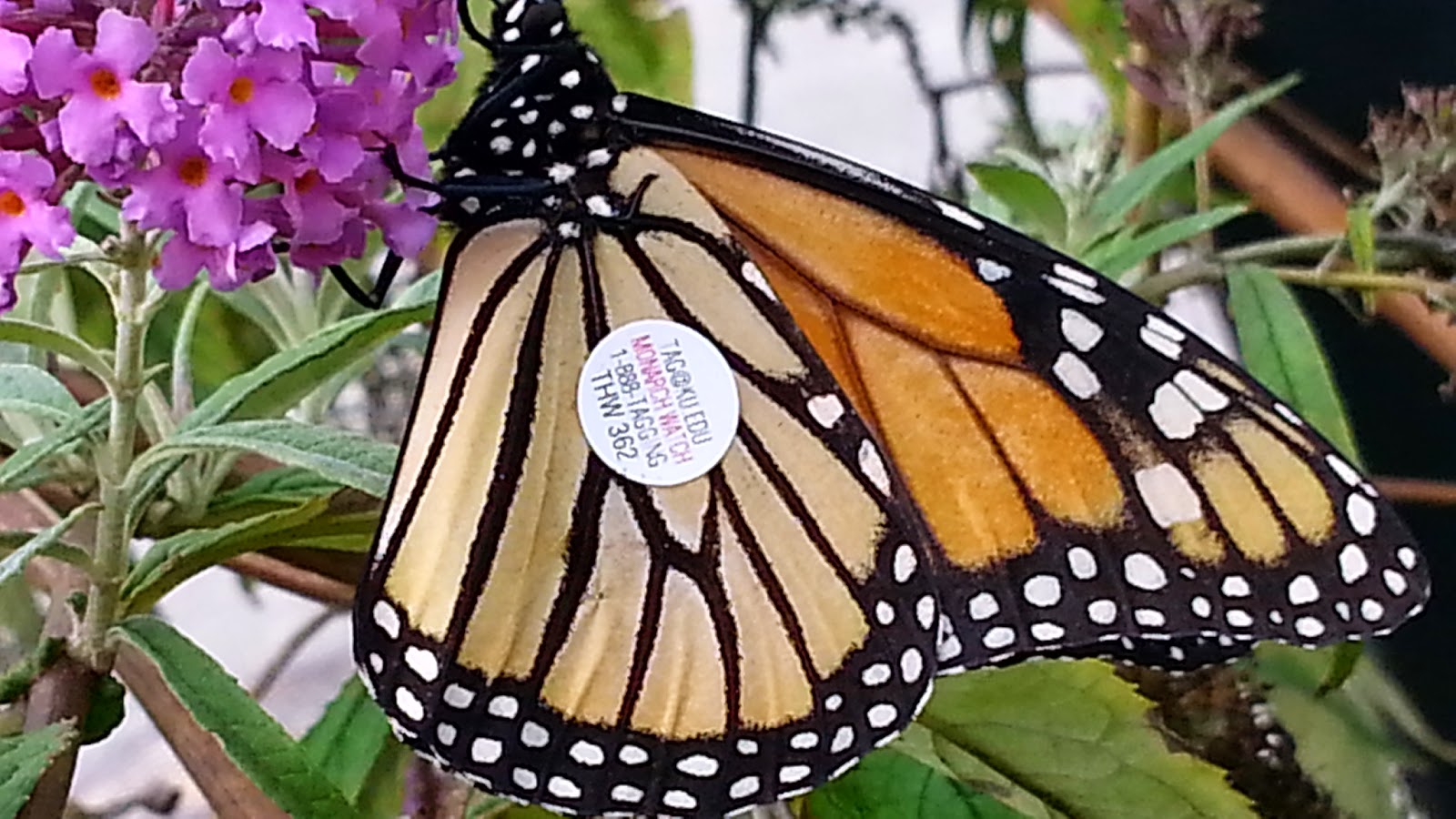
Having seen a tagged monarch while we were banding in the morning, we decided to check out the tagging demo run by the CMBO. There was an excellent introduction to the scheme and all about the life cycle, their threats and migration of the butterflies before the tagging started.

Quite amazing that they will have 4-5 generations in a year but it is only the last one, after August, that migrates south to spend the winter in Mexico. They then return to the southern States where they breed and die. They never return back to New Jersey. Tagged individuals have been recorded flying over 500 miles in 3 days!!

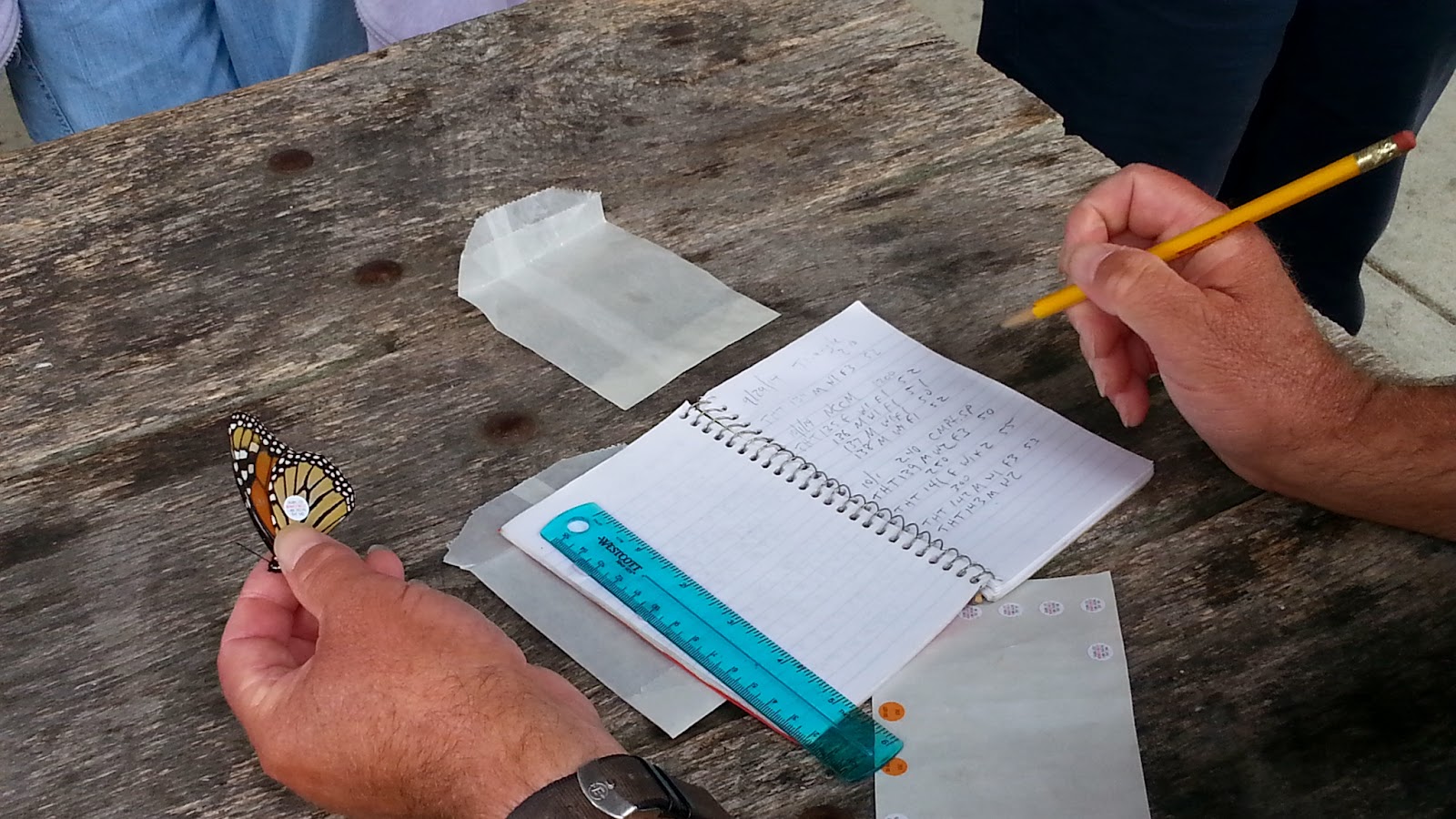
The monarchs are caught and a tagged with a small sticker on the underwing with a unique number. They are sexed, the wing condition is assessed, fat stores recorded and the wing is measured before it is released.

Still amazes me that they undertake such a long migration and can even reach the UK. 

Pic 1 - the tagged monarch we saw feeding in the morning. The tag has an individual number and email address to report it to
Pic 2 - male monarch. They have thinner black lines (look more orange) and have black spots on the hindwing
Pic 3 - female monarch. The black lines are much thicker and they don't have the black spots
Pic 4 - one of the CMBO volunteers explaining about the tagging
Pic 5 - the monarchs are kept cool and in a small breathable bag to stop them flapping too much
Pic 6 - wing condition checked for wear
Pic 7 - a small patch of wing scales are rubbed off before the tag can be applied. This causes no harm to the butterfly and doesn't fall off
Pic 8 - wing length taken. This can be up to 56mm but the average is about 50mm. The same as a goldcrest!!
Pic 9 - data recording
Pic 10 - release
Pic 11 - shows the migration routes the monarchs are taking.

Tuesday, 30 September 2014

All quiet on the western (weather) front

The weather has been in the east now for the last week and it has gone very quiet. As with most, if not all migration sites, when the conditions are right they offer some of the best birding you can imagine.  When the conditions are not right it can be very tough going.

Today was one of those days.

Started off at Higbee Wood but it was a real struggle to find any warblers. The few that were around were very mobile and I only managed to get onto an American redstart and a probable blackpoll warbler so i gave up after an hour.
Dropped in to see if Patti was banding but I think the early rain had put her off so it was on to Lily Lake.

Things were slow but there did seem to be more cardinals about and there was a nice movement of blue jays. They are only resident in small numbers so a flock of 79 over were definitely migrants.
There really didn't seem to be any birds until we came across a feeding flock in some cedars. The majority of the flock was at least 20 yellow rumped warblers but there was also 4 'tooting' red breasted nuthatch,  ruby crowned kinglet, several chickadee, yellow warbler and 2 Cape May warblers, one of which was a very smart male. The flock was very mobile and almost as soon as we had found them they were gone!
All nice stuff but its nothing like last week.

WE NEED A WESTERLY WEATHER FRONT PLEEEEEEASE

Monday, 29 September 2014

All at sea

Hit the tourist trail a bit today and decided to go on a dolphin/whale watching trip this afternoon.  We decided to go on the longer 3hr trip in the hope of getting a seabird to two and maybe a migrating humpback whale that pass through the area.

In the end it turned out to be a nice trip but wasn't very productive.  As we passed out through the harbour there was a nice roost of American oystercatcher on the breakwater and a 1st summer male black scoter in the harbour mouth.
The first part of the trip was along the front of Cape May looking for bottle-nosed dolphins. This was very successful with several groups seen including at least one small youngster. We had decent views through bins but photography was tricky.

We then turned and steamed out into deeper waters up to 3 miles offshore in the hope of whales. Despite the boat using fish finding equipment to locate whales we couldn't find any this time. Bird interest was also limited with only 2 black scoter and 2 Arctic skua seen.

A quick walk around the block at the end of the day proved fruitful with solitary sandpiper added to the trip list (163)

Pic 1 the best I could do with the dolphins on my phone!
Pic 2-6 Cape May from the water

Out and about

Today we headed north of the Cape May canal for about an hour to a large wetland site called Brigantine. The main part of the site is an 8 mile wildlife drive around some coastal lagoons and saltmarsh. The site is best know for its large numbers of wintering snow geese and ducks but it was still pretty good today.

To find clapper rail I was told to check the saltmarsh creeks at low tide and you will find one. Well, the first creek checked and there was a juv rail feeding along the edge :-)
The other target for the day was to try and add some more sparrows to the list. Unlike at home, there are more than two species and they all seem to be a nightmare to ID in my eyes. I thought I did pretty well getting savannah, swamp, chipping and seaside especially as the all look the same!!

The main part of the drive is around 700 acres of tidal lagoons and reedbeds. Jammed in on a flying American bittern on the way out but it was the sheer numbers of egrets, herons, cormorants and terns that were amazing. As the tide came up, water floods into the lagoons bringing in fish. The egrets (100 great at least) were feeding around the edges while the cormorants were feeding in tight groups with forsters terns diving amongst them. It was difficult to estimate but there was easily 500 double crested cormorants on the site.

Duck numbers were not great yet but we had over 200 black duck, 150 pintail, 70 teal, 6 lesser scaup and a single hooded merganser. On the freshwater pools on the edge of the site we had 15 wood ducks including several gaudy drakes.

11 new species were added to the trip list from the site taking it on to 162.

Pic 1-7 views over Brigantine lagoons and saltmarsh including the skyline of Atlantic City in the distance
Pic 8 roosting Caspian and Forsters terns
Pic 9-10 greater yellowlegs
Pic 11 record shot of a brown thrasher
Pic 12 juv sora

Saturday, 27 September 2014

Quiet day

After a week of full on birding, today seemed to be a bit of a slow one.
We started at Higbee Wood and although there was a reasonable warbler flight, nothing was stopping. They would land in the trees briefly before flying off high. We did manage to add two new species for the trip in the form of red headed woodpecker and yellow bellied sapsucker.
By 8am things were quiet so we headed off to do some banding.

Although it is much quieter that we are used to, it is great getting to grips with some new species. The first one today was a really nice swamp sparrow. Many of the American sparrows look pretty dull in the fieldguides but in real life and especially in the hand, they are really quite smart.
We had the now common catbirds and yellowthroats then BOOM, a black and white warbler!!!
There aren't really enough words to describe how stunning they are in the hand and I was so happy to be able to handle such a great bird. The next stunner was a blue jay with so many different shades of blue on it.

We have been banding in the garden of Richard Crossley and while we were chatting in between birds he had a text saying there was a zone tailed hawk over the Hawk Watch. I didn't realise the significance of the record but we rushed up to Richards rooftop viewing platform. We couldn't relocate the bird and I realised why Richard was gutted as it turns out to be the 1st record for Cape May!! I wasn't too gutted and it was really good to talk raptor id with Richard with an awesome view.

Ended the day with a walk on the beach and the skimmer/tern roost

Pic 1 tufted titmouse
Pic 2 swamp sparrow
Pic 3-5 black & white warbler
Pic 6-8 blue jay
Pic 9 cardinal
Pic 10 juv mourning dove
Pic 11 female black throated blue warbler
Pic 12 sunset Cape May style